Co-innovation support from lab concept to commercial material release
Mitsubishi Chemical helps product teams connect molecule selection, formulation behavior, analytical testing, regulatory evidence, and scale-up economics. Our service model is built for buyers and engineers who need more than a catalog entry: they need practical guidance on purity, viscosity, residual solvents, moisture control, metals, packaging, shelf life, and qualification documents.
Every program starts with the application target, then translates that target into measurable chemistry. For semiconductor customers, that can mean sub-ppb contamination targets and clean packaging. For polymer or coating customers, it may involve adhesion, weatherability, thermal cycling, or recycled-content goals. The objective is to shorten iteration loops while keeping the future manufacturing route realistic.
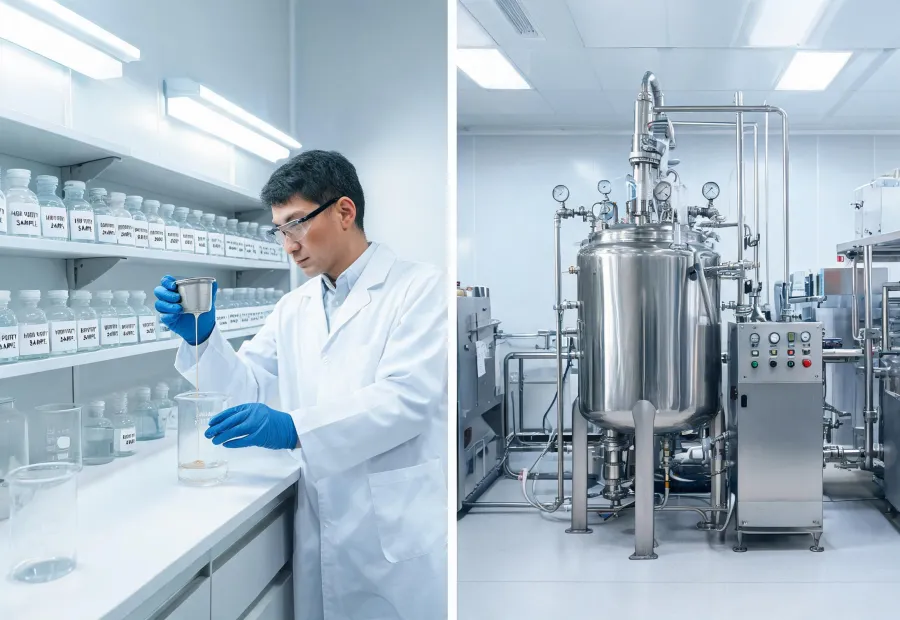
Lab screening
We compare candidate chemistries against the operating environment, including substrate compatibility, moisture sensitivity, metals risk, particle control, and handling requirements.
Pilot validation
Pilot batches verify mixing sequence, filtration, packaging, retain sampling, and analytical repeatability before customers commit qualification resources.
Commercial release
Supply, QA, and regulatory teams align specifications, SDS/TDS packages, change-control expectations, and logistics constraints for launch readiness.
A disciplined route from problem statement to qualified supply
Define
Clarify substrate, process window, regulatory region, safety limits, and target performance metrics.
Screen
Evaluate formulation families using relevant lab methods and practical availability constraints.
Analyze
Confirm purity, viscosity, moisture, metals, particle profile, residual solvent, and stability behavior.
Scale
Translate bench conditions into pilot batch parameters with attention to mixing and filtration.
Document
Prepare SDS, TDS, compliance statements, lot traceability, and change-control expectations.
Supply
Move to commercial ordering with packaging, logistics, and quality agreement details resolved.
Equipment and analytical capabilities
Programs are supported by practical testing resources rather than abstract promises. Common work includes HPLC purity confirmation, Karl Fischer moisture, ICP-MS trace metals, viscosity curves, particle counts, thermal analysis, GC residual solvent screening, and packaging compatibility checks. Pilot equipment can be configured for filtration, controlled addition, inert handling, and retain-sample workflows where application risk requires additional discipline.
| Capability | Typical output | Customer use |
|---|---|---|
| High-purity analytics | Moisture, metals, residuals, particles | Semiconductor and electronic chemical qualification |
| Formulation rheology | Viscosity, stability, shear response | Coatings, adhesives, and polymer process tuning |
| Pilot batching | Scale-up observations and retain samples | Commercial readiness and internal approval packs |
Bring your application window, target region, and qualification timeline.
We will help translate the requirement into a chemistry review and a practical next step.